
Dawn Raids: Inside Singapore’s $3B Money Laundering Bus
On August 15, 2023, Singapore’s calm cracked. The Singapore $3B money laundering case unfolded across Sentosa Cove and Rochalie Drive as 400 officers hit luxury homes. Supercars, golf club memberships, and Good Class Bungalows masked a network linked to Chinese gambling and Southeast Asian scam compounds. It was the city-state’s largest bust, and it pulled a hidden system into daylight.
At 38 Rochalie Drive, a domestic helper was going about her morning routine in the luxurious two-story bungalow she helped maintain. Inside the front yard sat two gleaming Toyota Alphards and a Rolls-Royce, casually parked as if their combined million-dollar value was merely pocket change. The house belonged to Wang Bingang and his wife Wang Liyun—though by the time the police arrived, their quarry had already vanished, leaving behind only expensive cars and bewildered household staff.
Down at the exclusive Sentosa Golf Club, where foreigners pay nearly $950,000 just for membership, Wang Bingang’s name had quietly appeared on the defaulters’ list—his account unpaid, his whereabouts unknown. The 34-year-old Chinese national who had built his criminal empire on a gambling platform named “Hongli International”—meaning “great profits” in Mandarin—had managed to slip through Singapore’s fingers just as authorities closed in on the most audacious money laundering operation in Asian history.
The Making of a Criminal Empire
Wang Bingang’s story reads like a twisted version of the American Dream transplanted to Southeast Asia’s criminal underworld. In 2012, at just 23 years old, this son of Fujian province’s Anxi county—a region Chinese media has dubbed “The Hometown of Fraudsters”—founded what would become a gambling empire worth hundreds of millions of dollars.
The young entrepreneur’s timing was perfect. China’s strict gambling laws had created massive pent-up demand among mainland Chinese punters, while the Philippines’ special economic zones offered a regulatory haven for operators willing to work in the shadows. Wang established Hongli International as a Philippine Offshore Gaming Operator (POGO), complete with Macau-themed branding designed to lend an air of legitimacy to what was, fundamentally, an illegal betting operation targeting Chinese citizens.
The business model was devastatingly effective: a pyramid-scheme recruitment network where gamblers could become promoters, earning commissions by inviting other players to the platform. Within three years, Hongli was processing nearly RMB 984 million ($135 million) in just six months. But success brought scrutiny, and in 2015, Chinese authorities arrested Wang, sentencing him to three years in prison.
Most criminals might have emerged from jail chastened, perhaps seeking legitimate employment. Wang Bingang was not most criminals. Upon his release around 2017-2018, he didn’t abandon his criminal enterprise—he relocated it to Singapore and began living openly among the city-state’s ultra-wealthy elite. If Chinese authorities had disrupted his operations in the Philippines, he would simply rebuild them in Cambodia’s notorious border town of Bavet while using Singapore as his personal refuge and money laundering hub.
Living Among Singapore’s Elite
What made Wang’s Singapore strategy so audacious was its brazenness. Rather than hiding in the shadows, he integrated himself into the city-state’s most exclusive social circles. The Sentosa Golf Club membership wasn’t just a status symbol—it was camouflage, a way to present himself as a successful international businessman rather than a fugitive criminal.
The choice of Rochalie Drive as his residence was equally calculated. This isn’t just any expensive neighborhood—it’s part of the Chatsworth Park Good Class Bungalow Area, Singapore’s largest and most prestigious GCB enclave. Properties here routinely sell for $40-70 million, and the street’s most famous resident is Prime Minister Lee Hsien Loong himself. The high level of security, including CCTV cameras and Gurkha guard posts, made it an ideal hiding place for someone seeking to blend into Singapore’s ultra-wealthy elite.
Wang wasn’t alone in this strategy. Court records would later reveal that all 10 individuals arrested in the August raids originated from the same Fujian county and maintained close family and business relationships dating back over a decade. They had collectively acquired multiple passports from countries including Cambodia, Vanuatu, St. Kitts & Nevis, Cyprus, and Dominica—purchased citizenships that allowed them to present themselves as legitimate international businesspeople.
The criminal network established at least 16 different companies in Singapore, creating a complex web of corporate structures designed to legitimize their presence. Their combined assets would eventually total over $3 billion, including 152 properties, 62 luxury vehicles, 483 designer handbags, 169 branded watches, 68 gold bars, and a crystal Kawai grand piano worth $240,000.
The Art of Hiding in Plain Sight
The sophistication of the money laundering operation was breathtaking in its simplicity. Rather than employing complex financial engineering, the criminals relied on forged bank documents and multiple corporate identities to substantiate their wealth to Singapore’s financial institutions. When questioned about their sources of funds, they provided flexible explanations—initially claiming wealth from Chinese loan businesses, then switching to cite real estate investments and gambling winnings in the Philippines.
The multiple passport strategy proved particularly effective. Su Haijin, one of the convicted money launderers, simultaneously held Cambodian citizenship while maintaining extensive property investments in London, including two adjoining properties in Oxford Circus purchased for $56 million in December 2021. Wang Shuiming, another network member, used forged financial statements from a legitimate company to justify his wealth to Singapore banks.
The network’s Dubai investments were equally audacious. Wang Bingang, Chen Zhiqiang, and Ke Wendi purchased at least 22 properties worth $28 million in the emirate between 2021 and 2023, with some suspects buying out entire floors of luxury skyscrapers overlooking the Burj Khalifa. These weren’t desperate attempts to hide money—they were confident investments by criminals who believed they were untouchable.
How the Singapore $3B Money Laundering Case Was Built
Singapore authorities had been tracking suspicious activities since 2021, when financial institutions began flagging forged documents used to substantiate sources of funds. But this wasn’t a case of sudden discovery—it was a methodical, three-year investigation that revealed the massive scope of the criminal network.
The early stages required extraordinary discretion. Police kept the investigation to a small group of officers, avoiding any enforcement actions that might alert the suspects. As one source noted, “To avoid alerting the suspects, the police investigation was kept to a small group of officers and no enforcement or overt investigative actions were taken at this stage”.
By early 2022, authorities had uncovered a complex web of individuals connected through family ties and business relationships. The probe revealed not just individual criminals, but an organized transnational syndicate that had systematically exploited Singapore’s financial system for years. As investigators dug deeper, they discovered more individuals and more assets, building a case that would eventually encompass billions of dollars in illicit wealth.
The August 15, 2023 raids were the culmination of this patient investigation. More than 400 officers conducted simultaneous operations across Singapore, targeting luxury properties in Sentosa Cove, Tanglin, Orchard, Holland Village, and River Valley. The scale was unprecedented—10 arrests, more than $1 billion in immediate asset seizures, and the exposure of a criminal network that had been hiding in plain sight for years.
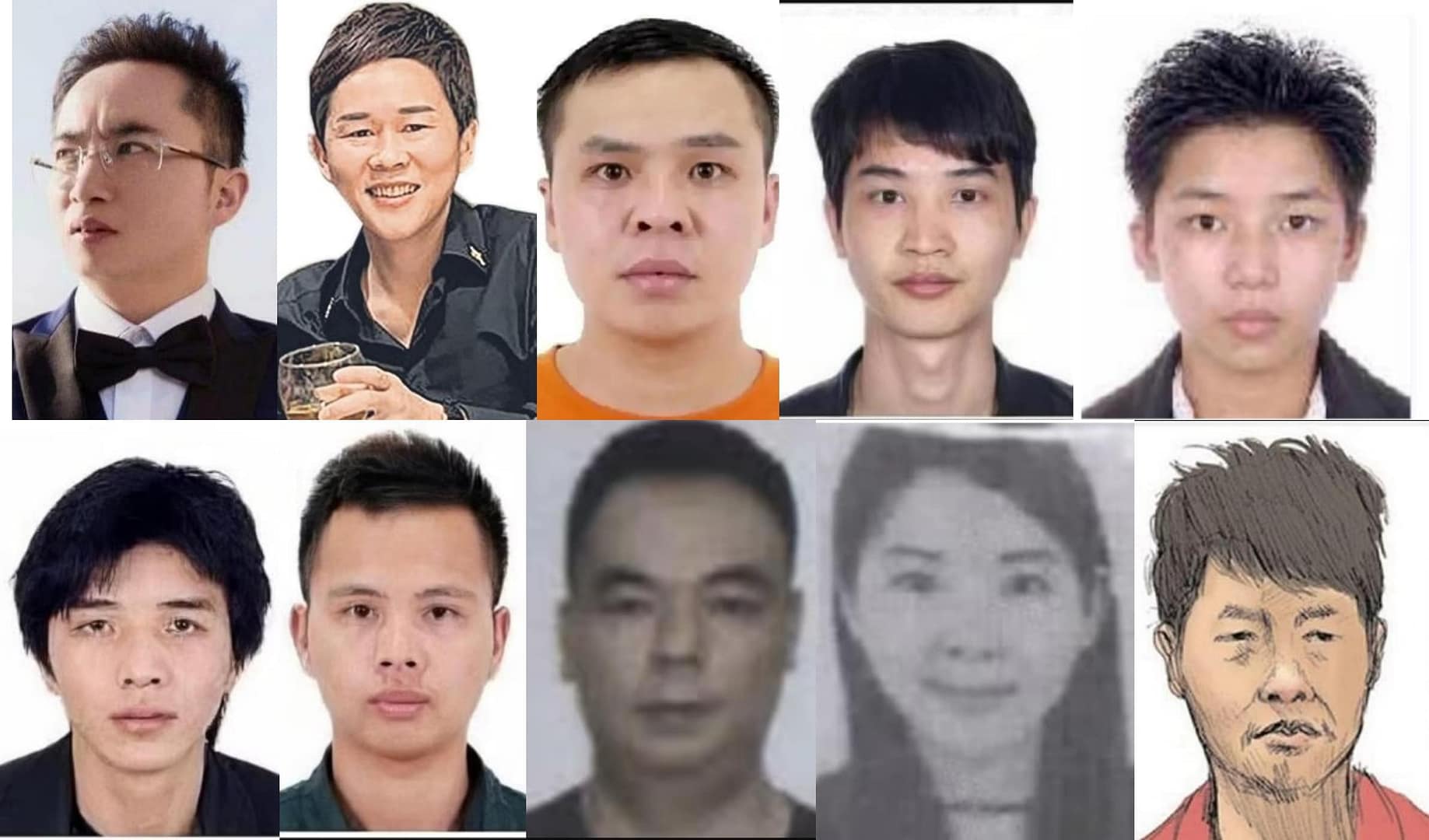
Picture: 10 arrested suspect
The Missing Mastermind
Wang Bingang’s escape remains one of the most frustrating aspects of the entire case. Despite living openly in Singapore for years, maintaining a golf club membership, and residing on the same street as the Prime Minister, he somehow evaded one of the most comprehensive law enforcement operations in Singapore’s history.
The circumstances of his disappearance suggest either exceptional luck or inside information. When reporters visited his Rochalie Drive bungalow after the raids, they found his domestic helper still maintaining the property, claiming her employers were in Singapore but “not at home” during the arrests. The family’s continued presence at the residence, combined with Wang’s unpaid golf club membership, suggested a hasty but not panicked departure.
Wang’s criminal empire continued to operate even after his escape. Court proceedings revealed ongoing connections to “Hengbo Baowang Group,” which reportedly employed 10,000 people across the Philippines and Cambodia and generated $687 million monthly in turnover. This wasn’t a criminal on the run—it was a CEO temporarily relocating while his business continued to function.
The Regulatory Earthquake
The aftermath of the Singapore scandal triggered one of the most comprehensive regulatory overhauls in the city-state’s history. In July 2025, the Monetary Authority of Singapore imposed $27.45 million in fines on nine major financial institutions, including Credit Suisse, UOB, UBS, and Citibank. These penalties represented the second-largest cumulative AML fine in Singapore’s history, approaching the $29.1 million assessed in connection with Malaysia’s 1MDB scandal.
The regulatory failures were systematic and comprehensive. Financial institutions had established proper AML policies on paper, but failed catastrophically in implementation. MAS found inadequate customer risk assessments, failures to verify sources of wealth for high-risk customers, insufficient monitoring of flagged transactions, and weak customer due diligence processes. Perhaps most damaging was the revelation that some institutions had ignored suspicious transactions that were originally flagged by their own internal systems.
The Ministry of Law penalized three law firms for AML breaches over property purchases linked to the case, while another three law practices received reprimands. Five lawyers were referred to the Law Society for potential disciplinary action, and inquiries into 11 other firms remained ongoing. Two property agents were also fined for failing to conduct proper customer due diligence on clients linked to the case.
The Human Cost
Behind the staggering financial figures lay a human trafficking dimension that authorities are still uncovering. The criminal network’s operations in Cambodia and the Philippines relied on forced labor from trafficked workers, many lured by fake job advertisements promising legitimate employment. Court records revealed connections to scam centers where victims were forced to conduct “pig-butchering” operations—elaborate schemes involving fake romantic relationships designed to defraud victims of their life savings.
The scale was enormous. Wang’s cousin, Wang Baosen, was allegedly connected to operations that had trapped thousands of workers in compounds across Southeast Asia. These weren’t just gambling sites—they were comprehensive criminal enterprises offering money laundering, cryptocurrency conversion, and sophisticated cyberfraud services.
The Global Implications
The Singapore case has become a template for understanding modern transnational money laundering. The operation demonstrated that even the most regulated financial centers can be systematically exploited through a combination of multiple passports, shell companies, forged documents, and the simple strategy of operating openly rather than covertly.
The international ramifications extended far beyond Singapore’s borders. Investigations revealed that 15 other suspects had fled Singapore during the probe, taking with them knowledge of the network’s operations and client base. In November 2024, authorities negotiated the surrender of $1.85 billion in assets from these fugitives in exchange for withdrawing Interpol Red and Blue Notices—effectively allowing the masterminds to escape prosecution while retaining their freedom.
The case also highlighted the vulnerability of Special Economic Zones and citizenship-by-investment programs. The criminals’ multiple passports from Vanuatu, St. Kitts & Nevis, Cyprus, and Dominica allowed them to present themselves as legitimate international businesspeople rather than Chinese nationals evading gambling restrictions. These programs, designed to attract foreign investment, had become enablers of international financial crime.
The Technology Challenge
The Singapore case revealed how criminals are staying ahead of technological detection systems. The money laundering network employed sophisticated document forgery, multiple digital identities, and complex transaction patterns designed to avoid triggering algorithmic detection systems. Their ability to maintain operations for years while living openly in Singapore suggests that current AML technology is inadequate for detecting well-resourced, patient criminal networks.
The challenge for compliance teams is that they must detect not just individual suspicious transactions, but complex behavioral patterns that may unfold over years and span multiple institutions. Financial institutions in Singapore have responded by investing heavily in AI-driven compliance systems, but experts warn that criminals are simultaneously upgrading their own technological capabilities.
The Liquidation Process
Nearly two years after the raids, Singapore continues the complex process of liquidating seized assets. In August 2025, authorities handed over 466 luxury items and 58 gold bars to professional services firm Deloitte for management and liquidation. The items included Hermès Birkin bags worth $30,000, Hermès Kelly Alligator bags valued between $70,000-$120,000, a Patek Philippe World Time Chronograph worth $120,000, and a Richard Mille RM 67 valued at over $400,000.
The gold bars alone—each weighing 1kg and valued at approximately $139,000—represented just a fraction of the total seized assets. As of February 2025, 54 properties, 33 vehicles, and 11 country club memberships had been liquidated, with proceeds totaling $1.8 million paid into Singapore’s consolidated fund. Another $390 million was pending similar payment.
The Sentosa Golf Club membership seized from the criminals was valued at $550,300, while a Singapore Island Country Club membership was worth $410,000. These weren’t just status symbols—they were liquid assets that could be quickly converted to cash, demonstrating the criminals’ sophisticated understanding of Singapore’s luxury asset markets.
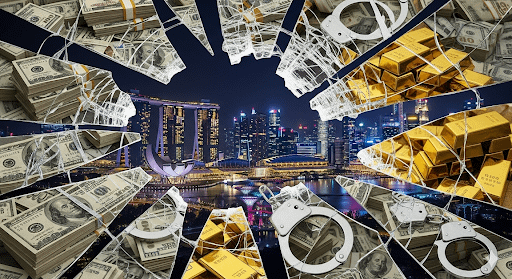
Lessons from the Lion City
The Singapore money laundering case offers sobering lessons about the evolution of international financial crime. First, geographic reputation provides no protection against sophisticated criminal networks. If criminals can successfully operate for years in one of the world’s most regulated financial centers, no jurisdiction can consider itself immune.
Second, the case demonstrates the critical importance of real-time cross-institutional monitoring. The fact that criminals successfully moved funds through 16 different Singapore financial institutions suggests that current approaches to information sharing are inadequate. Banks need systems that can identify customers and suspicious patterns across institutional boundaries, not just within their own operations.
Third, the case highlights the continued vulnerability of high-value real estate markets to money laundering. The criminals’ ability to purchase properties worth hundreds of millions of dollars in Singapore, London, and Dubai without triggering meaningful scrutiny suggests that real estate remains one of the easiest ways to launder large sums of illicit funds.
The Unfinished Story
As of September 2025, Wang Bingang remains at large, his Hongli International gambling empire continues to operate, and investigations into 11 law firms remain ongoing. The $3 billion Singapore case may represent not an aberration, but a glimpse into the true scale of illicit finance flowing through the world’s most prestigious financial centers.
The criminal network’s patient, methodical approach—living openly among Singapore’s elite while systematically exploiting the financial system over multiple years—suggests a level of sophistication that current regulatory frameworks struggle to address. With an estimated 95-98% of global money laundering flows going undetected, the Singapore case serves as a stark reminder that the most successful criminal strategy may not be hiding in the depths of the internet, but rather hiding in plain sight within the legitimate financial system itself.
The luxury cars still sit in Wang Bingang’s Rochalie Drive driveway, the domestic helper continues to maintain his house, and somewhere in the world, the mastermind of a billion-dollar criminal empire remains free—a living symbol of how even Singapore’s vaunted regulatory system can be outsmarted by criminals patient enough to play the long game. The question isn’t whether there are other Wang Binggangs operating in other financial centers around the world—it’s how many more are out there, and how long they’ve been hiding in plain sight.