

TL;DR
A recent international takedown led to at least 276 arrests and the dismantling of at least nine scam centres used in cryptocurrency investment fraud schemes. The case matters because it shows that scam centres are not just rooms full of scammers. They are organised financial crime supply chains linking victim grooming, fake investment platforms, crypto transfers, mule accounts, laundering networks, recruiters, compounds and sometimes trafficked workers.
For AML teams, the lesson is practical. By the time money hits an account, wallet or exchange, the manipulation may already be complete. The transaction is only the visible edge of a much larger machine.
The Scam Message Is Only the Front End
In late April 2026, the U.S. Department of Justice announced a coordinated international operation involving the FBI, Dubai Police and China’s Ministry of Public Security. According to DOJ, the operation led to at least 276 arrests and dismantled at least nine scam centres used to run cryptocurrency investment fraud schemes against victims in the United States. Several defendants were charged in San Diego with federal fraud and money laundering offences.
That headline is important, but the bigger lesson sits underneath it. These cases are not just about one scammer convincing one victim to transfer money. They show how modern scam operations have become structured, specialised and cross-border. The person sending the message may be only the first visible layer. Behind that message can sit recruiters, handlers, fake investment platforms, crypto wallets, mule accounts, laundering groups and physical compounds built to keep the machine running.
That is why the better frame is not simply “crypto scams are rising.” The stronger point is that scam centres, crypto fraud and money laundering now operate like a financial crime supply chain. Each part of the chain has a role. Someone finds the victim. Someone builds trust. Someone controls the fake platform. Someone moves the funds. Someone launders the proceeds. Someone manages the workers, and in some cases, those workers may themselves be trapped.
This is where the topic becomes relevant for AML professionals. A bank, exchange or remittance provider may never see the scam compound. It may never see the script, the fake romance profile or the pressure applied to the victim. What it sees is the transfer, the wallet, the mule account or the attempted off-ramp. That is the final stage, not the full story.
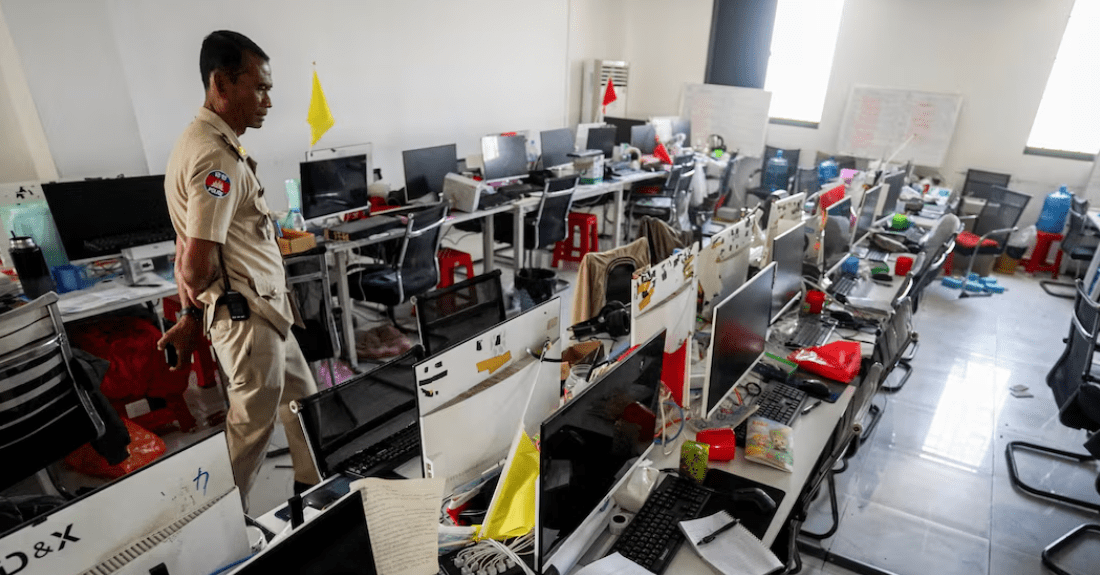
Image: Scame centres shut down in Cambodia
Fraud Is Becoming Industrial
INTERPOL’s 2026 Global Financial Fraud Threat Assessment gives this shift a useful label. INTERPOL warned that financial fraud has become one of the world’s most serious and rapidly evolving transnational crime threats, with fraud increasingly linked to organised crime, cybercrime, human trafficking and specialised money laundering groups. Its Secretary General described this as the “industrialization of fraud.”
That phrase matters because it moves the discussion away from the old idea of scams as isolated deception. Industrialised fraud has process, labour, infrastructure and scale. It uses cheap digital tools, social media, encrypted messaging, fake platforms and cross-border value movement. It also adapts quickly. If one payment rail becomes harder to use, the network can shift to another. If one jurisdiction increases pressure, the operation can move or rely on different facilitators.
In that sense, scam centres look less like random criminal call rooms and more like production environments. They have scripts, targets, training, performance pressure and defined roles. Some workers groom victims over weeks or months. Others manage the fake investment platforms that show false profits. Others help move funds through digital assets, mule accounts or shell structures. The victim sees a convincing relationship or investment opportunity. The criminal network sees workflow.
This is the part AML teams need to understand. The payment is rarely the beginning. It is usually the moment where all the earlier work becomes visible to the financial system. By then, the victim may already trust the scammer, believe the fake platform, and feel emotionally committed to the transaction.
Pig-Butchering and the Slow Build of Trust
DOJ described the fraud as “pig-butchering,” a term used for scams where criminals build trust over time through friendship, romance or personal connection before steering victims into fake investment platforms. Victims may be encouraged to open accounts, transfer cryptocurrency, invest more, or even borrow from family, friends or lenders. Once the funds are moved into the fake platform, victims lose control of the money.
The phrase is ugly, but the method is important. These scams do not always begin with obvious urgency. Some begin with warmth. A friendly message. A slow conversation. A person who seems patient, successful or emotionally available. Over time, the victim is moved from trust into action. The investment platform appears to work. The balance appears to grow. Then the victim is pushed to put in more.
That slow build makes detection difficult. From the outside, the first payments may look voluntary. The customer may not sound distressed. They may even appear confident because the scammer has coached them. In many cases, they are not trying to hide from the bank because they think they are committing fraud. They are trying to move quickly because they believe they have found an opportunity.
For AML and fraud teams, that creates a difficult challenge. The customer may look like a willing participant while actually being manipulated. The transaction may look like an investment while actually being theft. The crypto transfer may look like personal choice while sitting inside a wider laundering chain.
The Human Cost Cuts Both Ways
There is another uncomfortable layer to scam centres. The victims are not always only on one side of the screen.
In April 2026, the U.S. Treasury sanctioned Cambodian senator Kok An and associated entities over alleged scam centre networks. Treasury said scam centres linked to Kok An operated out of casinos and office parks that had been retrofitted for fraudulent activity. It also said fraudsters used friendship or romance-style approaches to coax vulnerable victims into transferring savings through fake digital asset investment opportunities.
The human detail is worse. Treasury said that in some cases, people carrying out the scams were themselves victims of human trafficking and were forced to commit unlawful acts under threat of violence. It also said trafficking victims reported being held at scam facilities and forced to steal money from victims to repay the cost of being abducted.
That does not excuse the harm done to scam victims. People lose savings, homes, relationships and dignity. But it does change the way we should understand the criminal model. The person sending the message may be exploiting the victim. In some cases, that person may also be trapped inside the same machine.
This is why scam centres should not be treated as a simple cybercrime issue. They sit at the intersection of fraud, trafficking, organised crime and money laundering. The emotional manipulation of the victim is one part of the model. The coercion of workers may be another. The movement of value is what connects both sides to the financial system.
Where AML Teams Enter the Supply Chain
Australian institutions may not see the compound in Cambodia, Myanmar, Dubai or elsewhere. They may not see the recruiter, the handler, the fake trading dashboard or the threat made against a trafficked worker. But they may see the downstream movement of money.
That is where AML teams enter the story. They may see a customer suddenly liquidating savings. They may see transfers to crypto exchanges that do not match the customer’s history. They may see mule accounts receiving funds from unrelated people. They may see rapid movement through wallets, high-risk jurisdictions, payment references that do not make sense, or customers who sound coached when questioned.
This is also where the topic connects with earlier Australian enforcement lessons. In the Airwallex AUSTRAC audit, the broader issue was whether a fast-moving cross-border payments business had controls that matched its risk profile. In the CBA money laundering scandal, the lesson was that high-volume transaction patterns only matter if systems are built to detect and escalate them. The scam centre supply chain sits in the same family of risk: large-scale movement of value, repeated patterns, and the danger of treating the transaction as ordinary because the system has seen something similar before.
The Singapore $3B money laundering case also shows why professionalised laundering networks matter. Scam proceeds rarely stay in their original form. They need to move, layer, convert and eventually land somewhere useful. That may involve digital assets, mule accounts, shell companies, luxury goods, property or other stores of value. The scam is the front end. Laundering is how the proceeds survive.

The Desk-Level Lesson
For practitioners, the first lesson is that the transaction is often the last visible step. By the time funds reach an account, wallet or exchange, the victim may already have been groomed for weeks. A purely transactional view can miss the emotional and logistical machinery that produced the payment.
The second lesson is that crypto fraud is not just a cyber issue. It has clear AML dimensions because value has to move through accounts, wallets, exchanges, mules, OTC channels and off-ramps. If those movements are treated as separate from the fraud that created them, the institution only sees fragments of the supply chain.
The third lesson is that customer vulnerability matters. A customer who seems rushed, secretive or unusually committed to a transfer may not simply be careless. They may be coached, emotionally manipulated or convinced that any delay will cost them an opportunity. That does not mean every unusual transfer is a scam. It means staff need enough curiosity and authority to slow the moment down when the story does not fit.
The final lesson is that mule accounts are not random endpoints. They are infrastructure. A mule account receiving funds from victims is part of the same machine as the fake investment platform and the scam compound. If AML teams treat mule activity as a low-level account problem, they risk missing the organised network behind it.
Conclusion: The Visible Edge of a Larger Machine
Scam centres are not just rooms full of people sending messages. They are increasingly organised financial crime supply chains. The front end may look like romance, friendship or investment advice. The back end may involve crypto wallets, mule accounts, laundering groups, shell companies and cross-border protection.
That is what makes the recent international takedown important. The arrests and dismantled centres matter, but the deeper lesson is structural. Modern fraud is not only becoming more digital. It is becoming more industrial.
For AML teams, the challenge is to look beyond the single transaction. A payment to an exchange, a mule account receipt or a wallet transfer may be only the visible edge of a much larger machine. The harder job is to understand what may have produced that movement and whether the customer, the account or the funds are part of a wider supply chain.
The scam message starts the story. Money laundering is how the story continues.